Race day fueling: what to eat before and during your run
3 hours, 1 hour, 15 minutes, then the road. The countdown that keeps your tank full and your stomach calm.

· 8 min read
Yes, you can eat honey mid-race. In a University of Memphis trial, honey improved cyclists' race times about as well as a dextrose sports gel [4]. Honey isn't magic, though. The real work happens across one countdown: 3 hours, 1 hour, 15 minutes before the start, then out on the road.
Most race-day blow-ups are not about fitness. They come from running out of usable carbohydrate, or from a stomach that rebels against the wrong food at the wrong time. Both are avoidable.
This guide follows the same countdown as our carousel. Each step explains what to eat, how much, and the physiology behind it, drawn from the joint sports nutrition position statement of the American College of Sports Medicine (ACSM), the Academy of Nutrition and Dietetics and Dietitians of Canada [1], plus the research it rests on.
Why fuel matters: the science in 60 seconds
At race pace, carbohydrate is your premium fuel. Fat is plentiful but slow to burn. Carbohydrate releases energy faster, and the harder you run, the more you lean on it.
The catch is storage. Your body keeps carbohydrates as glycogen in your muscles and liver, and the tank is small. That's why the ACSM position statement reserves full carb-loading (10–12 g per kg of body weight per day, for 36–48 hours) for events longer than 90 minutes [1]. Shorter efforts rarely drain it.
When glycogen runs low, two things happen. Your muscles lose their fastest fuel, so pace drops even though effort stays high. Your liver also struggles to keep blood glucose steady, and your brain feels it first. Runners call it hitting the wall.
Fueling is only half the equation. The other half is your gut. During a hard run, blood flow shifts from your digestive system to your working muscles. Food that's hard to digest (high in fat, fiber or protein) sits in the stomach longer. That's when cramps, sloshing and emergency toilet stops show up.
The countdown
3 hours before: breakfast
- Eat:
- Oatmeal, banana and honey, or bread with jam
- How much:
- 2–3 g carbs per kg (≈ 130–195 g at 65 kg)
- Why:
- Restock liver glycogen, with time to digest
Eat a high-carb breakfast that's low in fiber and fat. The ACSM position statement recommends 1–4 g of carbohydrate per kg of body weight, eaten 1–4 hours before exercise [1]. The further out you eat, the more you can eat. Three hours gives your stomach time to empty, so aim for the middle of that range: about 2–3 g per kg.
For a 65 kg runner, that's roughly 130–195 g of carbohydrate. One way to get there: a bowl of oatmeal made with about 80 g of oats (approx. 50 g carbs), a sliced banana on top (approx. 25 g) and two tablespoons of honey (about 34 g [6]). Or swap the oats for two slices of white bread with jam (approx. 50 g).
Poha, idli or plain white rice work just as well if that's what your stomach knows. Carbohydrate restocks liver glycogen, which drops overnight while you sleep. A little protein (a glass of milk, a spoon of curd) keeps you from feeling hungry at the start line. Low fiber and fat speed up digestion, so the meal has left your stomach before you run.
This is not the morning to try a new high-fiber cereal. Save the experiments for training days.
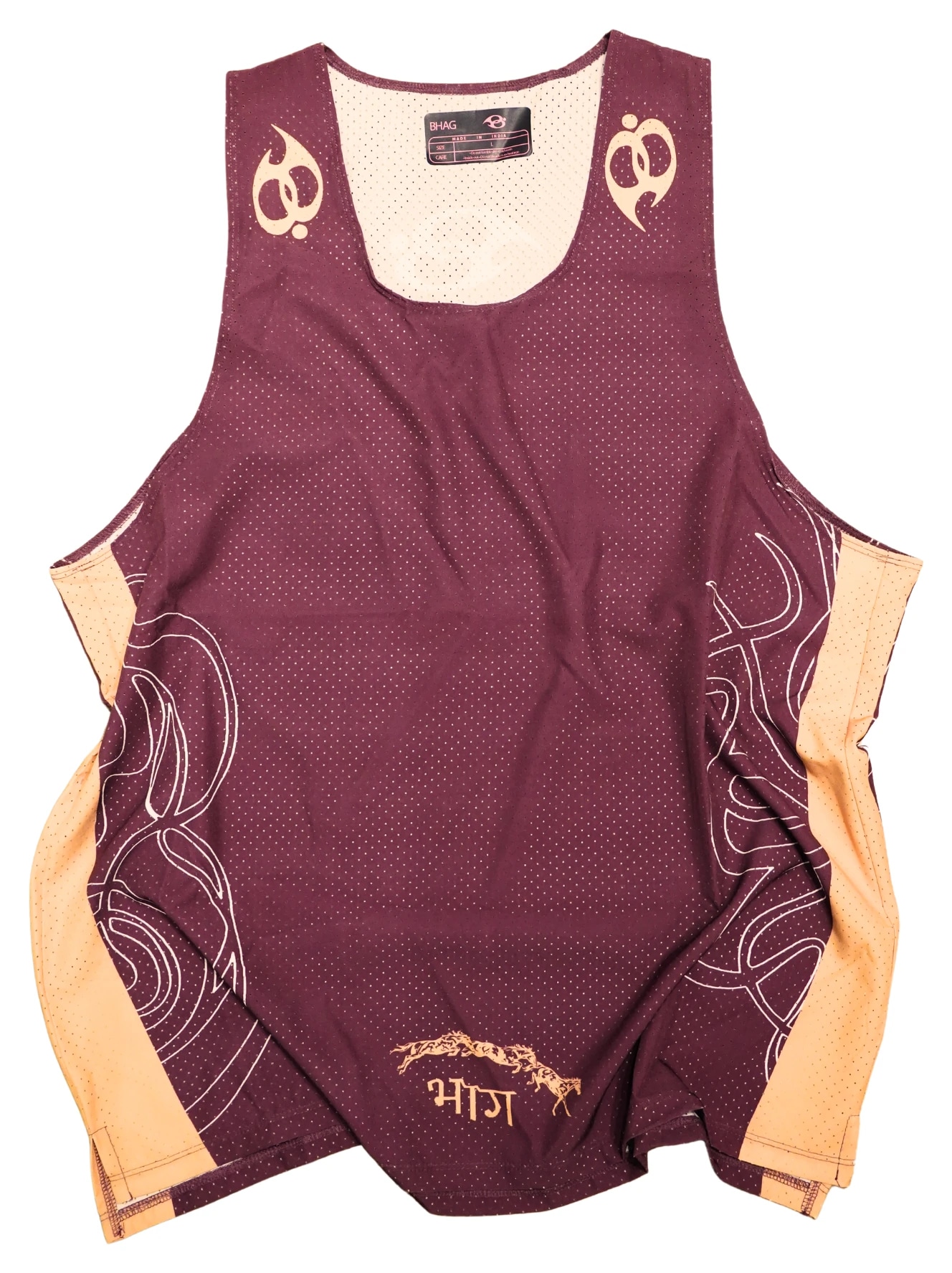
Wear itWild Strides Tee - Ivory

BHAG Club 1 hour before: carb snack
- Eat:
- A banana, or 2–3 dates
- How much:
- ≈ 25–50 g carbs
- Why:
- Top up without loading the stomach
Keep it small and simple. That's roughly 25–50 g of fast carbohydrate, at the low end of the ACSM range, because there's less time to digest.
An hour out, the goal is not to fill the tank. It's to top up blood glucose and the liver without loading the stomach. Ripe bananas and dates are mostly simple sugars, with little fat or protein to slow them down. They're also easy to carry to a start pen.
Nothing new on race day. Your gut adapts to what you feed it in training. A food that works for your running partner can still cramp you. If you haven't eaten it before a long run, don't eat it before a race.
BHAG Club 15 minutes before: top off
- Take:
- 1 gel, or a few sips of sports drink
- How much:
- ≈ 15–25 g carbs
- Why:
- Glucose goes straight to working muscle
Most commercial sports drinks are 6–8% carbohydrate, so 250 mL delivers about 15–20 g.
Carbohydrate taken this close to the start doesn't have time to cause a blood-sugar dip before you're moving. Once you start running, your muscles pull glucose in to use it, so it goes straight to work during the first kilometres.
Sip, don't chug. A large volume of fluid right before the gun sits in your stomach as you start bouncing down the road. A sloshing stomach at kilometre 2 is no fun. Small sips give you the carbohydrate without the slosh.
BHAG Club During the run: flash fuel
- Take:
- Gel, chews, sports drink or honey every 30–45 min
- How much:
- 30–60 g/h (up to 90 g/h past 2.5 h)
- Why:
- Hold off the wall
On runs longer than about 75 minutes, take a gel, a few chews or some sports drink every 30–45 minutes. How much you need depends on how long you'll be out there.
BHAG Club



| Run duration | Carbohydrate during the run | Source |
|---|---|---|
| Under 45 min | None needed | ACSM 2016 |
| 45–75 min | Small amounts, or simply rinsing a sports drink around your mouth | ACSM 2016 |
| 1–2.5 hours | 30–60 g per hour | ACSM 2016 |
| Over 2.5–3 hours | Up to 90 g per hour, from a mix of glucose and fructose | ACSM 2016; Jeukendrup 2013 |
The mouth rinse is a real effect. Receptors in your mouth sense the carbohydrate and signal the brain, which can lift performance even though you don't swallow it.
Why the glucose + fructose mix matters
Your gut absorbs glucose through one transporter, and it saturates at around 60 g per hour. Fructose uses a different transporter. Combining the two opens a second lane. In lab studies, glucose plus fructose raised carbohydrate burning by up to 65% compared with glucose alone, and improved cycling power by about a further 8% [3]. These studies used trained cyclists, so the exact numbers may differ for runners. The principle holds, though: for long races, mixed sugars go further.
So what about honey?
Honey is roughly 40% fructose and 30% glucose [6]. That makes it a natural glucose + fructose fuel.
It also has evidence behind it. At the University of Memphis, Richard Kreider's lab tested honey against a dextrose (glucose) gel and a placebo in competitive cyclists. Riders took 15 g before a 64 km time trial and every 16 km after. Honey and the gel both improved times and power over placebo. The gel came out slightly ahead, but the researchers called the difference negligible [4].
Train your gut
Your gut is trainable, just like your legs. In a 2018 randomised trial by Ricardo Costa's team, runners who practised taking 90 g of carbohydrate per hour during daily 1-hour runs for two weeks reported fewer gut symptoms. Their carbohydrate malabsorption, measured by breath hydrogen, roughly halved (from 13 to 6 ppm). They also ran further in a test effort (12.3 vs 11.7 km). The placebo group didn't change [5].
The takeaway: practise your race fuel on long runs, at race pace, several times before race day.
Hydration: the quiet partner
Start hydrated, then drink enough to avoid losing more than 2% of your body weight. Above that level, aerobic performance starts to suffer, especially in heat. That's the guidance in the ACSM's position stand on fluid replacement [2].
- About 4 hours before: drink slowly, around 5–7 mL per kg (325–455 mL for a 65 kg runner).
- About 2 hours before: if you haven't needed to pee, or your urine is dark, drink another 3–5 mL per kg.
- During: water is fine for runs up to 90 minutes. Beyond that, a sports drink adds the carbohydrate and sodium you're sweating out.
- After: drink about 1.5 L for every kg of body weight lost.
Know your own sweat rate. Weigh yourself before and after a long training run: each kg lost is roughly a litre of sweat you didn't replace. Then plan to cover most of it. More isn't better, though. Drink to replace losses, not far beyond them.
The countdown at a glance
Screenshot this one for race morning. Amounts are for a 65 kg runner; scale them to your own weight.
| When | What | How much | Why |
|---|---|---|---|
| 4 h before | Water, sipped slowly | 5–7 mL/kg (≈ 325–455 mL) | Start fully hydrated |
| 3 h before | Oatmeal + banana + honey, or bread with jam | 2–3 g carbs/kg (≈ 130–195 g) | Restock liver glycogen; time to digest |
| 1 h before | Banana, or 2–3 dates | ≈ 25–50 g carbs | Top up without loading the stomach |
| 15 min before | 1 gel or a few sips of sports drink | ≈ 15–25 g carbs | Glucose goes straight to working muscle |
| During (75+ min) | Gel, chews, sports drink or honey every 30–45 min | 30–60 g/h (up to 90 g/h past 2.5 h) | Hold off the wall |
See you at the start line

Fueling isn't about perfection. It's about showing up to the start with a full tank and a calm stomach, and keeping both going for as long as the road asks. Practise it on your long runs, keep what works, and drop what doesn't.
Want a plan built for your next 10K, half or full?
We'll send you our free race day fueling guide.
Comment RACE on our postSources
- [1]Thomas DT, Erdman KA, Burke LM. Position of the Academy of Nutrition and Dietetics, Dietitians of Canada, and the American College of Sports Medicine: Nutrition and Athletic Performance. J Acad Nutr Diet. 2016;116(3):501–528.
- [2]Sawka MN, Burke LM, Eichner ER, et al. American College of Sports Medicine position stand: Exercise and fluid replacement. Med Sci Sports Exerc. 2007;39(2):377–390.
- [3]Jeukendrup AE. Multiple transportable carbohydrates and their benefits. Gatorade Sports Science Institute, Sports Science Exchange #108, 2013.
- [4]Kreider RB et al., University of Memphis. Honey vs. dextrose gel in competitive cyclists, presented at Experimental Biology. Reported in Scientific American.
- [5]Costa RJS et al. Two weeks of repetitive gut-challenge reduce exercise-associated gastrointestinal symptoms and malabsorption. Scand J Med Sci Sports. 2018.
- [6]International Food Information Council. What is honey? (sugar composition and carbohydrate per tablespoon).